China’s golf-cart supply chain serves golf courses, resorts, campuses, and other low-speed transport settings. Grand View Research’s 2024 Golf Cart Market report estimated the global market at about US$2.03 billion in 2023, with projected growth through 2030. That figure describes complete vehicles, not suspension components. Still, it signals a broader market where ride comfort, durability, and maintenance matter. Numbers can mislead.
Golf Cart Coil Over Suspension combines a spring and damper to help control wheel movement over uneven paths. For buyers, the small details count: mounting dimensions, spring rate, damper adjustment, corrosion protection, and replacement-part availability. A cart carrying passengers across cracked pavement needs a different setup from one used on smooth fairways. There is no universal best choice.
This guide introduces ten China-based suppliers and the questions worth asking before requesting a quotation. Compare technical drawings, material specifications, load and cycle-test evidence, customization capabilities, and export support. Ask how each supplier verifies fitment for your cart model; a polished catalog alone is not proof. Where test data or independent certifications are unavailable, treat performance claims cautiously and request supporting records. Supplier capabilities can change, so confirm current product details directly. The list is a starting point, not an endorsement. It is easy to overlook this, but a lower unit price may mean little if fitment, consistency, or after-sales support falls short.
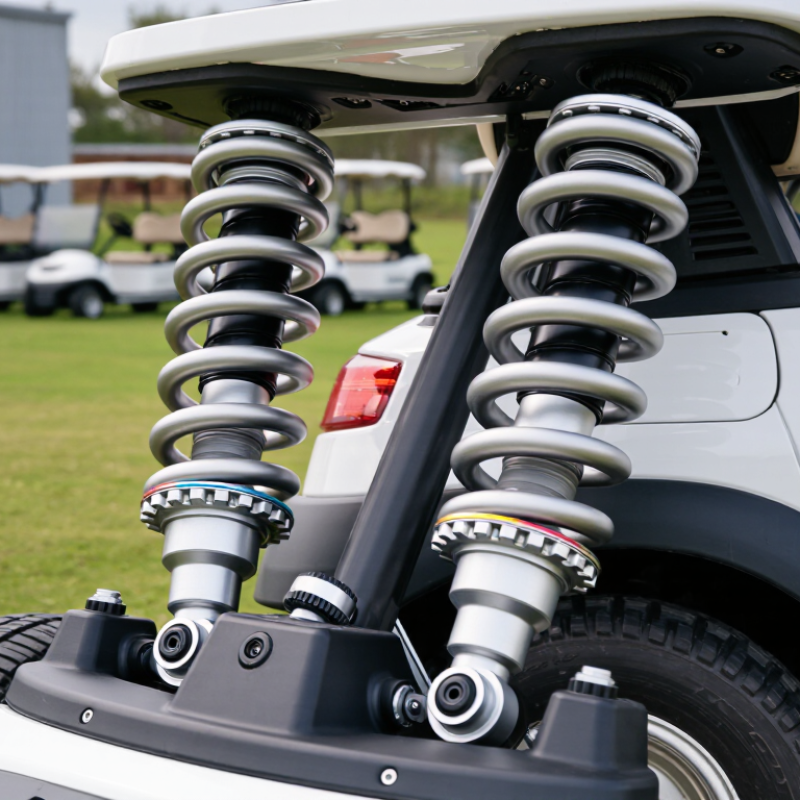
A golf cart coil-over suspension pairs a coil spring with a hydraulic shock absorber in one compact assembly. The spring supports the cart’s weight and absorbs bumps, while the shock controls how quickly the spring compresses and rebounds. Together, they help keep the tires in contact with uneven ground. The assembly typically includes upper and lower mounts, a spring seat, a damper body, and a piston rod. Small details matter. Mounting width, bolt diameter, and available travel must match the cart’s suspension geometry.
When a wheel hits a rut, the spring compresses around the shock. Hydraulic fluid moving through internal valves slows that movement, reducing bouncing after impact. Spring preload can change ride height and initial firmness, but it does not automatically increase the spring’s overall stiffness. Too much preload may create a harsh ride or reduce useful suspension travel. That trade-off is easy to overlook.
For supplier comparisons, check dimensions, load ratings, materials, and corrosion protection alongside price. Ask how testing reflects real cart loads and rough surfaces. A specification sheet helps, but fit should still be verified against the vehicle. Even a well-matched coil-over can feel different with passengers, cargo, or tire changes. Setup is not always predictable. A short road test on familiar terrain can reveal problems before they become costly.
China’s golf-cart suspension supplier landscape is shaped by a broad vehicle-parts manufacturing base, but suppliers differ in how deeply they specialize. Some focus on coil-over assemblies; others supply springs, dampers, mounts, or related components. For buyers, a neat product photo proves little. Ask for spring-rate data, damper test records, material specifications, and sample measurements. Check how the assembly clears the tire at full steering lock. Small details matter.
The China Association of Automobile Manufacturers reported 9.587 million new-energy vehicles produced in China in 2023. This figure describes the wider vehicle sector, not golf-cart suspension output. It suggests manufacturing capacity, but it cannot verify a supplier’s cart-specific expertise. This is an imperfect proxy.
When comparing the top ten suppliers, examine documented load tests, corrosion protection, production traceability, and consistency between samples and bulk orders. A supplier may quote quickly yet provide limited test evidence. That deserves a second look.
Grand View Research’s 2024 Golf Cart Market report also points to continued global market growth through 2030, supporting demand for reliable replacement and OEM components. Check the report’s scope before applying its forecast to a specific suspension category.
Assessing China’s golf cart coil-over suspension suppliers requires more than comparing prices. Request spring-rate charts, damper force curves, load limits, and test conditions. Confirm the quoted measurements match your cart’s axle load and intended terrain. A coil-over that looks substantial on a bench may still ride harshly on uneven turf.
Ask suppliers to document ride and vibration testing, including the cart’s load, speed, and surface. ISO 2631-1 evaluates whole-body vibration across 0.5–80 Hz, offering a useful framework for comparing measured seat vibration. It is not a golf-cart certification. Also check corrosion protection, bushing materials, weld inspection, and replacement-part availability. Small omissions matter. A missing rebound test can leave a real gap in the evidence.
Tips: Request a sample test report and verify its date, equipment, and test configuration. Compare like with like. If the supplier cannot explain a force curve in plain language, pause before ordering. Catalog data helps, but it may not reflect your exact vehicle or operating conditions. That uncertainty deserves a follow-up question.
Profiles of ten Chinese golf cart coil-over suspension suppliers are most useful when they compare engineering evidence, not sales claims. Grand View Research estimated the global golf cart market at about US$1.8 billion in 2022; this measures vehicles, not suspension components. Still, it signals a substantial market for durable ride systems. A polished catalog proves little.
The profiles can distinguish suppliers by capabilities: spring winding, shock-body machining, damper assembly, custom tuning, corrosion protection, load testing, fatigue testing, small-batch production, export documentation, and application support. Ask each supplier for spring-rate data, usable travel, rated load, and test conditions. Check whether quoted fatigue life reflects a defined load and test cycle. Details matter. A supplier may offer a low price yet provide limited tuning records; that is worth noting, not concealing. Compare drawings, sample parts, coating specifications, and inspection reports before judging consistency. Grand View Research’s market estimate offers context, but it cannot verify any factory’s quality. Supplier-level claims need direct evidence.
| Profile | Supplier Profile Type | Potential Product Scope | Fitment Information to Request | Evidence to Check | Buyer Verification Step |
|---|---|---|---|---|---|
| Profile 1 | Golf-cart suspension specialist | Coil-over shock assemblies and related mounting components | Cart make and model, model year, front or rear position, and mounting dimensions | Product drawings, dimensional tolerances, and application-specific references | Compare the supplier drawing with measurements from the intended vehicle. |
| Profile 2 | Vehicle-parts manufacturer with suspension capability | Shock absorbers or coil-over assemblies alongside other vehicle components | Extended and compressed lengths, mount style, spring-seat position, and clearance | Current product specifications and manufacturing-process information | Confirm that the quoted part is designed for the stated cart application. |
| Profile 3 | Custom-engineering supplier | Application-specific spring and damper configurations | Vehicle load, intended use, available travel, and installation constraints | Approved drawings, revision control, and documented change approval | Approve a prototype and fitment results before placing a production order. |
| Profile 4 | Aftermarket replacement-parts supplier | Replacement coil-over units for specified cart applications | Original part reference, vehicle configuration, and left/right or axle position where applicable | Compatibility list supported by application records or validated samples | Check the listed application against the vehicle identification and existing part. |
| Profile 5 | Private-label production supplier | Coil-over assemblies manufactured to a buyer’s agreed specification | Drawing ownership, labeling requirements, packaging, and order quantity | Written specification, sample approval, and production inspection records | Set acceptance criteria and approve a pre-production sample in writing. |
| Profile 6 | Spring-focused component supplier | Coil springs or spring-and-damper assemblies, depending on capability | Spring dimensions, end form, material specification, and intended load conditions | Material documentation and inspection results for the agreed spring specification | Verify spring characteristics and installed clearance on the target vehicle. |
| Profile 7 | Damper-focused component supplier | Shock absorbers or integrated coil-over units | Stroke, body dimensions, mounting interfaces, and operating orientation | Performance data tied to a stated test method and test conditions | Request comparable test conditions; do not compare results with different methods. |
| Profile 8 | Machining and fabrication supplier | Mounting brackets, sleeves, spacers, and other suspension hardware | Interface dimensions, material, finish, and required clearances | Dimension inspection records and material or coating specifications | Check the complete installed assembly for alignment and interference. |
| Profile 9 | Export-oriented parts supplier | Configured assemblies and export packaging for international orders | Destination-market requirements, packaging method, and shipment quantities | Commercial documents, packing details, and agreed inspection documentation | Confirm product specifications and shipment terms separately in the purchase order. |
| Profile 10 | Multi-category golf-cart parts supplier | Coil-over suspension products supplied with other cart components | Exact application, component interfaces, and any related parts needed for installation | Itemized quotation, product drawings, and a clear statement of included components | Confirm that the quotation covers the complete required assembly, not just selected parts. |
| Note: These are anonymous supplier-profile categories for screening, not verified profiles of ten identified companies. Supplier capabilities, product availability, certifications, and application compatibility should be confirmed directly and documented before purchase. | |||||
When sourcing coil-over suspension suppliers in China, begin with the cart’s actual load, terrain, and mounting dimensions. A supplier should ask about passenger capacity, battery weight, tire size, and typical operating surfaces. These details affect spring rate, shock travel, and clearance. A product that fits on paper may still bind at full compression.
Customization should be documented in a drawing, including eye-to-eye length, spring specifications, mounting hardware, and finish. Ask whether samples can be tested on the intended cart before a larger order. Small details matter. Check weld consistency, thread condition, and whether adjustment collars move smoothly. For quality assurance, request material and inspection records, then agree on measurable acceptance criteria before production. Inspect sample units and a random portion of finished goods; photos alone cannot reveal every issue. Keep spare springs or seals in mind if carts work in dusty, uneven areas. One practical caution: extra stiffness can feel reassuring, but may reduce comfort and traction on rough paths. The right setup depends on use, not just appearance.
Sourcing, Customization, and Quality Assurance Considerations
The chart shows the publication years of selected standards that buyers may reference when assessing quality systems, environmental management, occupational health and safety, and corrosion-test methods. Edition years do not indicate supplier certification, product compliance, or a required corrosion-test duration; verify current certificates and agree on product-specific acceptance criteria with each supplier.
It combines a coil spring and hydraulic shock absorber. The spring supports weight; the shock limits bouncing.
The spring compresses around the shock. Hydraulic fluid passes through internal valves, slowing compression and rebound. Less bouncing follows.
No. Preload can change ride height and initial firmness, but it does not automatically increase spring stiffness. Too much may reduce travel.
Check mounting width, bolt diameter, available travel, and tire clearance at full steering lock. Small mismatches matter.
Request spring-rate charts, damper force curves, load limits, material details, and dated test reports. Photos are not enough.
Match the cart’s load, speed, and surface. Seat-vibration measurements can help, but one test may not reflect every route.
Moisture and rough use can expose weak finishes or bushings. Ask about weld inspection and parts availability, too.
Not always. Passengers, cargo, and tires change how a setup feels. A short test on familiar ground can reveal problems. Still, results can surprise you.
This article introduces the components and operating principles of Golf Cart Coil Over Suspension, explaining how the coil spring and shock absorber work together to support vehicle weight, absorb bumps, and improve handling. It also surveys China’s supplier landscape and outlines practical criteria for evaluating potential manufacturers, including engineering capability, production consistency, material selection, communication, and after-sales support.
Profiles of ten Chinese suppliers offer a structured starting point for comparing capabilities without treating any single option as the right fit for every buyer. The article also covers sourcing and customization, from defining vehicle specifications and load requirements to confirming dimensions, finishes, and performance expectations. Attention to sample evaluation, inspection procedures, and quality assurance can help buyers reduce mismatches and build a more dependable supply relationship.